How did the flags of different LGBTQ+ identities come about?
We see them at pride marches, on social media as symbols of friendship, in shop windows… But where did they come from and what do they represent? Today, we'll introduce some of them!

Rainbow Flag
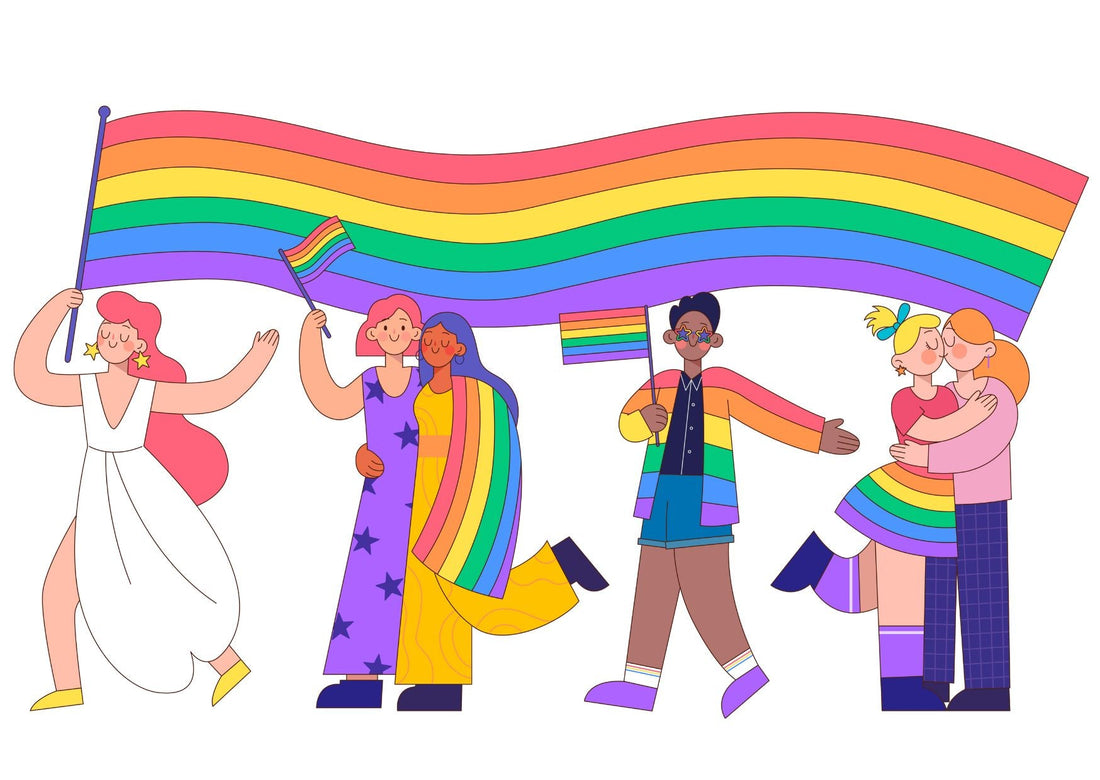
We've likely encountered several versions: The first, with six horizontal stripes, was designed in 1978 by artist Gilbert Baker, living in San Francisco, who created it at the request of then-supervisor Harvey Milk, who was also the first openly gay person in that position in California.

In 2017, black and brown stripes were added to the flag, created by the Office of LGBT Affairs in Philadelphia, USA. What was the reason? The purpose of the new version was to introduce a new flag that would also consider non-white LGBT+ people. A year later, American designer Daniel Quasar developed this version, introducing a new one: It includes not only the original six stripes designed by Gilbert Baker but also a chevron with black, brown, blue, and pink stripes and a white triangle. The new colors represent trans* people and people living with HIV or AIDS.

In the same year, however, another rainbow flag was created, with a yellow triangle instead of white and a purple ring inside it. This represents intersex people. This version was created by Valentino Vecchietti from the United Kingdom.
Transgender Flag
The three-color flag, consisting of three stripes (blue, pink, and white), is significantly newer than the rainbow one: It was created in 1999. Its author, Monica Helms, an American transgender activist, incorporated all trans identities into it: male, female, and those that do not fit into either category.
However, according to Helms, the flag's design was not very thought out; she herself described it as "a strike from above."
Non-binary Flag
As we probably already know, there isn't just one non-binary identity: non-binary people can be gender-neutral, have several genders at once, or perhaps none, or be at their intersection… And precisely these identities are represented by the non-binary flag by Kye Rowan* from 2014 – when they were seventeen years old.

The flag consists of four horizontal stripes: yellow, which represents people who are neither cis men nor cis women; white, which represents people of many genders; purple, which represents people at the intersection of genders; and finally black, which represents people with no gender.
Intersex Flag
This flag differs from many others representing LGBT+ identities in that it does not consist of stripes but rather a purple ring on a yellow field. Its author is bioethicist and intersex activist Morgan Carpenter from Australia, who introduced it to the world in 2013.

And why was this geometric shape chosen? This symbol represents the wholeness of intersex people: intersex identity does not make anyone flawed or bad.
Asexual Spectrum Flag
We specifically write about the flag for people on the asexual spectrum, as this black-grey-white-purple flag represents precisely them. Black represents asexual orientation, grey represents orientation between asexuality and allosexual orientations, white represents sexuality itself, and purple represents community.

This flag emerged from a competition on the English-language website AVEN (Asexuality Visibility and Education Network) in 2010, with the winning entry submitted by an account named standup. AVEN then used the same colors for its logo.
Given that there are several asexual and aromantic, or borderline, identities, there are many flags similar to this one that refer to these gender identities or sexual orientations.
Bisexual Flag
The bisexual pride flag is among the relatively older ones, having been created in 1998. Its author is Michael Page, living in Florida, who also created the now-defunct discussion forum BiCafe.com. The flag first appeared on this site.

It consists of three stripes of unequal size: one wide, blue, representing heterosexuality; a second wide, red, representing homosexuality; and the last, which is significantly thinner than the previous ones, is purple and represents their combination.